Automated trading systems that a human can monitor and stop.
Termondt Tech builds the infrastructure behind a systematic trading operation: market data, decision support, automated execution and risk controls, with hard safety rails in place from the first day. In 2026 I guided an AI coding agent to build and run one against a real brokerage account, then shut its first strategy down on the evidence. The write-up is public, including what went wrong.
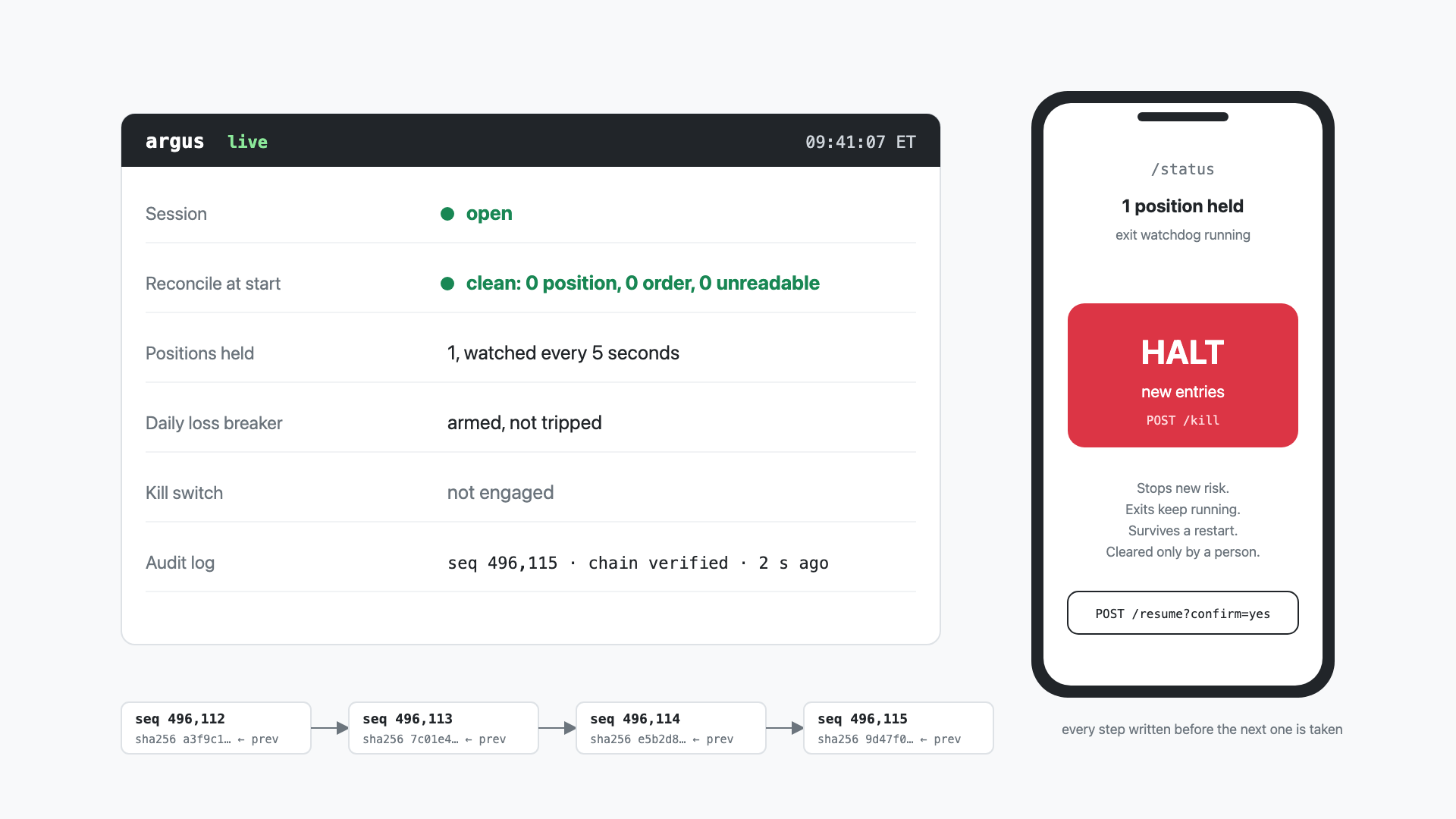
What I build
One problem, worked deeply: infrastructure precise enough to run a live trading operation automatically, and transparent enough that a person can see what it is doing and stop it.
Market data and decision support
Pipelines that take in live market data, score opportunities against a defined strategy, and put ranked, explained decisions in front of a person. Built to support judgment, not replace it.
- Real-time data pipelines and broker integrations
- Signal engines that write every decision to an audit log
- Status pages and alerts a person can read on a phone
Automated execution and risk controls
Systems that place, watch and close trades by rule, with the rails that make that safe: one place in the code that can send an order, limits enforced twice, and a kill switch that halts new risk without abandoning the positions it is protecting.
- Kill switches, loss breakers and fail-closed halts
- Reconciliation against the broker before anything resumes
- Invariants pinned by tests that read the source
Monitoring and operational reliability
The part that keeps an automated system honest: a hash-chained audit trail, continuous reconciliation, and alerting that fires when something is wrong, including when the thing that is wrong is silence.
- Hash-chained audit logs with one enforced writer
- Continuous reconciliation against the source of truth
- Staged rollout: shadow, sandbox, then live at minimum size
Two ways to work with me
Both come from the same fourteen weeks and the same fourteen years.
Rails Review
Two weeks. For teams putting AI-written code into production.
I read your agents' prompts, their output and your tests, and hand back the two things most AI-built systems are missing: a written constitution, the rules the agent has to obey no matter what it is asked, each with its reason, and the pinned invariants, tests that prove the dangerous thing cannot happen anywhere in the code.
Trading infrastructure, built and operated
For a trading or investment operation that needs execution, risk controls or reconciliation.
Built to run automatically, and to be monitored and stopped by a human. That is what I did for fourteen years at the New York Stock Exchange and Chicago Trading Company, and what Argus is: a platform that went from first commit to a real brokerage account in nine weeks, under rails that held when the strategy did not.
How I build
The same loop whether the code is written by me or by an AI agent I am directing. Most of the work is in the first step and the last.
Specify
Build
Prove
Operate
The evidence
Argus, July to October 2026. Written by an AI agent under my direction and review, run against real money at minimum size, and documented as it went.
435
3,540
87
741
1
Part one
I guided an AI to build and run a live trading desk. Here is what it took to make that safe.
The constitution, the kill switch that forgot it was pressed, the day the agent opened the live database, and ten rules for a CTO letting AI write software that can hurt them.
Part two
How a strategy earns capital: the research platform behind Argus
Four commits in a fixed order, one look at the held-out period, nine predictions that all came true, and a strategy that still did not pay. How to know you are not fooling yourself.
How I operate
Automated and watched
25 years in trading infrastructure
Narrow, deep focus
Evidence over spin
Get in touch
If your team is putting AI-written code into production, or you run a trading operation that needs execution, risk controls or reconciliation built to run automatically, use the contact form and tell me what you are running.